> For the complete documentation index, see [llms.txt](https://docs.cw.crisisworks.com/llms.txt). Markdown versions of documentation pages are available by appending `.md` to page URLs; this page is available as [Markdown](https://docs.cw.crisisworks.com/concepts-and-fundamentals/on-a-computer/your-user-profile-and-duties/roster-availability.md).

# Roster Availability

## Overview <a href="#overview" id="overview"></a>

The Roster Availability is used to records the availability of [users](/system-administration/user-and-contact-administration.md) (usually staff) for a given shift.

Roster Availability is used with the Rostering functions but can be used standalone.

### Access <a href="#access" id="access"></a>

To access Roster Availability:

1. Go on duty to the event with a [supported position](#positions).
2. Use the *Manage My Rostering Availability* in the User Profile menu to access the module.

<figure><img src="/files/q8AszEjGHcoBSOHUtzw4" alt="" width="279"><figcaption><p>Manage My Rostering Availability in User Profile</p></figcaption></figure>

{% hint style="info" %}
If you can't access this link, contact your System Administrator. Roster Availability needs to be properly [setup and configured](#setup-and-configuration). Most built-in positions have **Roster Access** security policy. That means that you will be able to start using this module immediately to enter your own roster availability, so long as the register has been added to the event you're working in. To manage Roster Availability you must be signed in with either an Operations Officer position or a position with the Roster Access security policy.
{% endhint %}

### Operation <a href="#process" id="process"></a>

Once [setup and configured](#setup-and-configuration), Roster Availability records are created either by users or a Coordinator (refer to [Positions](#positions)).

Users can [add availability](#adding) if they have access to the register by adding dates, times and shifts that they are rostered on for. Coordinators can also add availability for any user including themselves.

When adding new records, the [Availability](#availability) is set to Available by default, although users can set this to either Available or Unavailable. The Unavailable status will override Available for the same date. So if a user is available for three months except for one week, they can create one 'Available' record for three months and one 'Unavailable' record for one week in the middle.

If you're working on an item it can be set to Draft.

For availabilities that have similar date ranges, shifts or users you can use the Template option.

If an item is no longer needed it can be set to Cancelled; Closed (Duplicate); or Closed (Error).

### Positions <a href="#positions" id="positions"></a>

The following table outlines [positions](/concepts-and-fundamentals/concepts-and-fundamentals.md#events-users-positions-and-duty) that can manage this register and what users with them can do according to their default security policies:

<table><thead><tr><th width="317.5859375">Position</th><th width="408.453125">Description</th><th data-hidden></th></tr></thead><tbody><tr><td>Operations Officer</td><td><ul><li>Add and edit their own availability</li></ul></td><td></td></tr><tr><td>Operations Coordinator</td><td><ul><li>Manage the availability of users</li><li><a href="#bulk-actions">Export</a> availability</li><li>View <a href="#reports">reports</a></li></ul></td><td></td></tr></tbody></table>

Other positions may have similar security policies. A [System Administrato](/system-administration/configuring-the-system/positions.md)r can establish positions with custom security policies.

### Setup & Configuration <a href="#setup-and-configuration" id="setup-and-configuration"></a>

Refer to: [Configuring the System](/system-administration/configuring-the-system.md) and [Administration](#administration)

To enable Work Summaries, an Administrator needs to:

1. [Add the Resources register to the Event](/system-administration/managing-events.md#positions)
2. [Add the appropriate Positions to the Event](/system-administration/managing-events.md#positions). Most positions support users adding Work Summaries. In addition [security policies](#security-policies) for Roster access can be assigned to any position.
3. \[Optional] Configure [shifts](#shift), a default 'Main' shift comes pre-installed.

#### Security Policies

Refer to: [Positions: Security Policies](/system-administration/configuring-the-system/positions.md#security-policies)​

<details>

<summary><strong>Security Policy explanations</strong></summary>

The following security policies apply to the Roster:

<table data-header-hidden><thead><tr><th width="268.61328125">Security Policy</th><th>Use</th></tr></thead><tbody><tr><td>Roster Access</td><td>Provides read-only access to the roster user interface.</td></tr><tr><td>Roster Coordinator</td><td>Provides full access to manage rosters</td></tr></tbody></table>

</details>

## Finding <a href="#finding" id="finding"></a>

{% content-ref url="/pages/Hqx2rS3kEW8IpmSxPLI7" %}
[Searching and Filtering](/concepts-and-fundamentals/on-a-computer/searching-filtering-and-querying-registers.md)
{% endcontent-ref %}

The find items you can use:

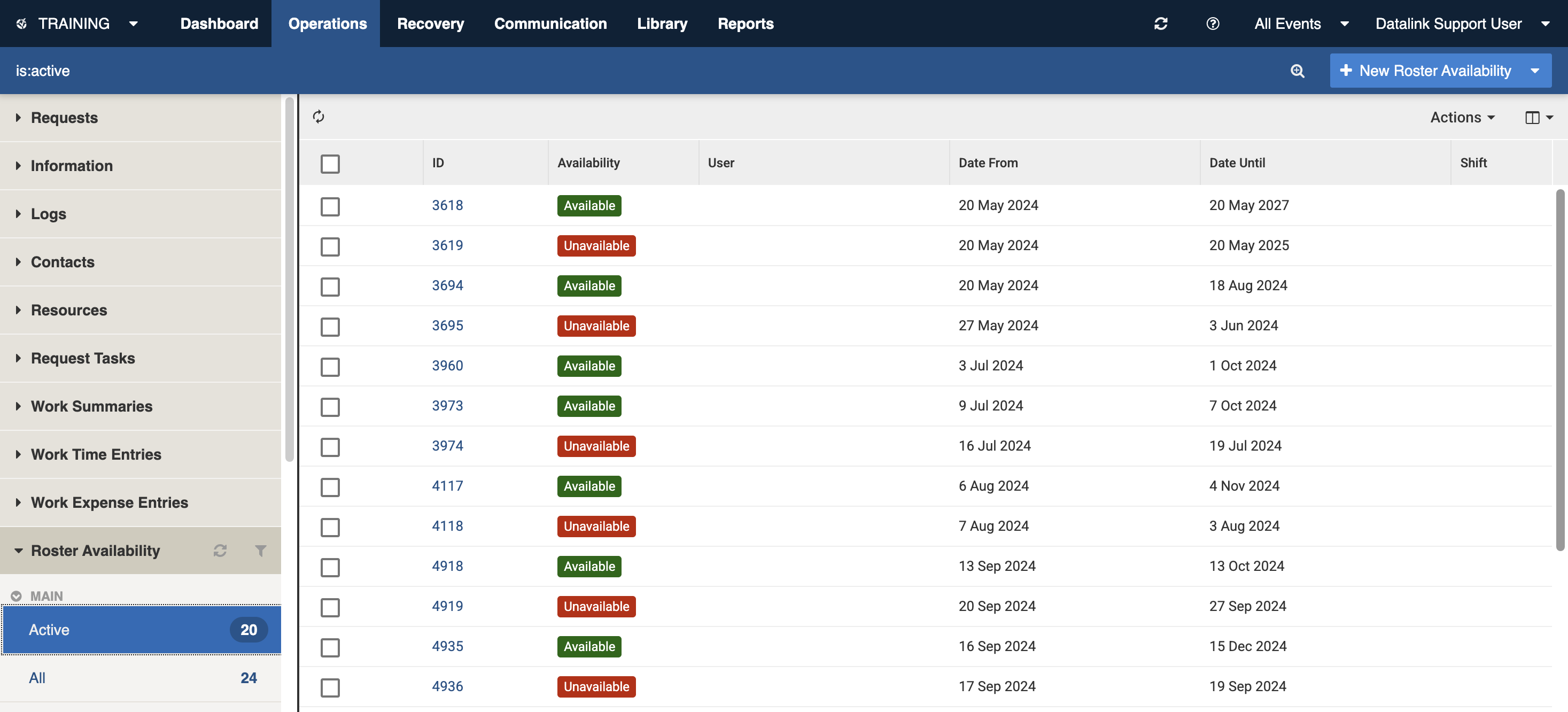
* [Datagrid](/concepts-and-fundamentals/on-a-computer/using-the-datagrid.md#data-grid-view) view
* [Filters](#information-editinganexistinginformationitem-1) including Active, Workflow (Available, Unavailable etc) and Unassigned
* A combination of filters and search by most fields

<figure><img src="/files/WpMvh6SZNRnqpAi2M7bl" alt=""><figcaption><p>Roster Availability datagrid (sample view)</p></figcaption></figure>

### Filters <a href="#filters" id="filters"></a>

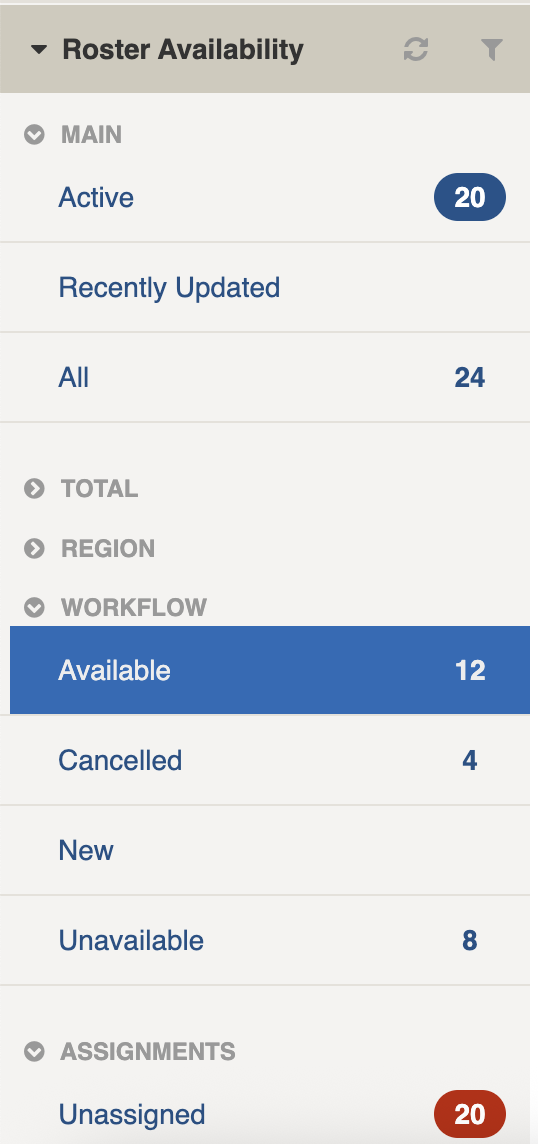
Filters help make management of Roster Availability easier by focusing on specific groups of items on the datagrid.

<figure><img src="/files/2CjSnrsXQkvbHHVzHNuM" alt="" width="135"><figcaption><p>Filters</p></figcaption></figure>

<details>

<summary>Filter menu explanations</summary>

The following lists some of the filters and how to use them:

<table><thead><tr><th width="132.140625">Filter Group</th><th>Filter/s</th><th>CQL</th><th>Use</th></tr></thead><tbody><tr><td>Main</td><td></td><td></td><td></td></tr><tr><td></td><td>Active</td><td><code>is:active</code></td><td>Finds all Active items (Available, Unavailable or New)</td></tr><tr><td></td><td>Recently Updated</td><td><code>is:active dateUpdated:>today-5d</code></td><td>Finds all items updated in the last 5 days</td></tr><tr><td></td><td>All</td><td><code>is:any</code></td><td>Finds all items in the register</td></tr><tr><td>Total</td><td></td><td></td><td></td></tr><tr><td></td><td>Active</td><td><code>toDate:>now-30d</code></td><td>Finds all items with an Date Until less than 30 days away</td></tr><tr><td></td><td>Mine</td><td>is:active userId:@me</td><td>Finds all items with you set as the User</td></tr><tr><td>Region</td><td>[List is based on your system configuration]*</td><td></td><td>Refer to: <a href="/pages/V0iTef0j5oJvtUziUjXe#sites-and-regions">Regions</a></td></tr><tr><td>Workflow</td><td></td><td></td><td></td></tr><tr><td></td><td>Available</td><td><code>status:available</code></td><td>Finds all items with <a href="#availability">Status</a> of Available</td></tr><tr><td></td><td>Cancelled</td><td><code>status:cancelled</code></td><td>Finds all items with <a href="#availability">Status</a> of Cancelled</td></tr><tr><td></td><td>New</td><td><code>status:new</code></td><td>Finds all items with <a href="#availability">Status</a> of New</td></tr><tr><td></td><td>Unavailable</td><td><code>status:unavailable</code></td><td>Finds all items with <a href="#availability">Status</a> of Unavailable</td></tr><tr><td>Active tags</td><td>[List is based on your system configuration]*</td><td><code>is:active #</code></td><td></td></tr><tr><td>Assignments</td><td>[List is based on your system configuration]*</td><td></td><td></td></tr><tr><td></td><td>Unassigned</td><td><code>is:active assigned:none</code></td><td>Finds all items where Assigned is not set</td></tr></tbody></table>

\* May vary based on your system configuration

</details>

## Opening and Viewing <a href="#opening-and-viewing" id="opening-and-viewing"></a>

{% content-ref url="/pages/Uj3SUzS7JZj9FENuBTeq" %}
[Viewing Items](/concepts-and-fundamentals/on-a-computer/using-the-datagrid/viewing-items.md)
{% endcontent-ref %}

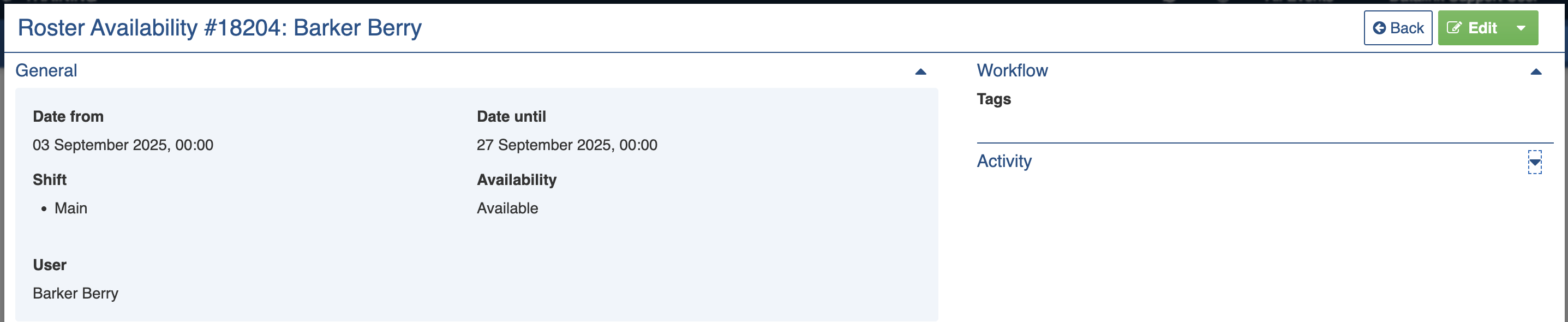
When viewing Roster Availability items, sections can be expanded to show information.

As each section is completed, new sections may show additional information.

<figure><img src="/files/ZcnHLABsgv7upRZ9lec2" alt=""><figcaption><p>Screenshot showing read only view of the General section. The user is available for most of the September.</p></figcaption></figure>

## Settings <a href="#settings" id="settings"></a>

Roster Availability has the following sections:

| Left Column                   | Right Column          |
| ----------------------------- | --------------------- |
| [Record Notes](#record-notes) | [Workflow](#workflow) |
| [General](#general)           | [Activity](#activity) |

### Record Notes <a href="#record-notes" id="record-notes"></a>

When editing, record notes in the [rich text field](/concepts-and-fundamentals/on-a-computer/using-the-datagrid/editing-items.md#rich-text-fields) as you make changes which will appear in the Activity log.

Refer to: [Recording Notes](/concepts-and-fundamentals/on-a-computer/using-the-datagrid/editing-items.md#recording-notes)

### General

The General section contains the main availability details with the [rich text field](/concepts-and-fundamentals/on-a-computer/using-the-datagrid/editing-items.md#rich-text-fields) provided.

#### Date From

Use this setting to set the date that the user is available from. This is required.

Refer to: [Setting Dates](/concepts-and-fundamentals/on-a-computer/using-the-datagrid/editing-items.md#selecting-dates)

#### Date until

Use this setting to set the date that the user is available until. This is required.

Refer to: [Setting Dates](/concepts-and-fundamentals/on-a-computer/using-the-datagrid/editing-items.md#selecting-dates)

{% hint style="info" %}
It is possible to set a Date until before the Date from, however do not do this as it can affect the availability results.
{% endhint %}

#### Shift

Use this setting to select the shift(s) from the list. This is required.

Once selected, these appear like tags and can be similarly removed by toggling them off the list with the cross.

<figure><img src="/files/zfTCOZWp7gNlzA3DxPLg" alt="" width="375"><figcaption><p>Shift setting with Main shift added</p></figcaption></figure>

Shifts are set up by your System Administrator using the Roster Availability Shifts [lookup](/system-administration/configuring-the-system/lookups.md).

#### Availability

Use this setting to whether the user is Available, Unavailable or something else.

<table><thead><tr><th width="130">Status</th><th width="143">Datagrid Icon</th><th>Notes</th></tr></thead><tbody><tr><td>Available</td><td><img src="/files/5sj1BkTMtTz0wzY1wpgg" alt="" data-size="line"></td><td>All new Roster Availability items begin with this status</td></tr><tr><td>Unavailable</td><td><img src="/files/SgIbC7UdvIFVCCaONppW" alt="" data-size="line"></td><td></td></tr><tr><td>New</td><td><img src="/files/vfMgfqbPDqm8wdwvHPnR" alt="" data-size="line"></td><td></td></tr><tr><td>Cancelled</td><td><img src="/files/hZv15TePAT5cyRjFax88" alt="" data-size="line"></td><td></td></tr></tbody></table>

For more information on statuses and workflow for Availability, refer to the [Roster Availability Workflow Data Dictionary](broken://pages/AwHsAIjt5Sh0QLrLBmmu#workflow).

#### User <a href="#workflow" id="workflow"></a>

Use this setting to select a user who the availability is for from the list.

If you don't select a user, it will default to your name (if you have a Roster Access security policy).

#### Details

Use this setting to add details on ths availability. For example, there might be notes about certain days or if the user has limited capacity. They can be added here.

### Workflow <a href="#workflow" id="workflow"></a>

#### Tags

Refer to: [tags](/concepts-and-fundamentals/on-a-computer/using-the-datagrid/tagging-items.md)

### Activity

Refer to: [Viewing Items: Activity](/concepts-and-fundamentals/on-a-computer/using-the-datagrid/viewing-items.md#activity)

## Updating <a href="#updating" id="updating"></a>

{% content-ref url="/pages/a2eWhKOkTwpBhWsPFV1g" %}
[Editing Items](/concepts-and-fundamentals/on-a-computer/using-the-datagrid/editing-items.md)
{% endcontent-ref %}

When updating an item:

* Add notes on your edits in the **Record Notes** field
* Complete each section of the [Settings](#register-item-settings) as required. Note that some options may open up new sections to complete.

<figure><img src="/files/qXj1yA0YKFgrWO0NIzdc" alt=""><figcaption><p>Editing a sample Roster Availability item</p></figcaption></figure>

## Adding <a href="#adding" id="adding"></a>

{% content-ref url="/pages/cRH8ZUNrgFGKBXlnlY6f" %}
[Adding Items](/concepts-and-fundamentals/on-a-computer/using-the-datagrid/adding-items.md)
{% endcontent-ref %}

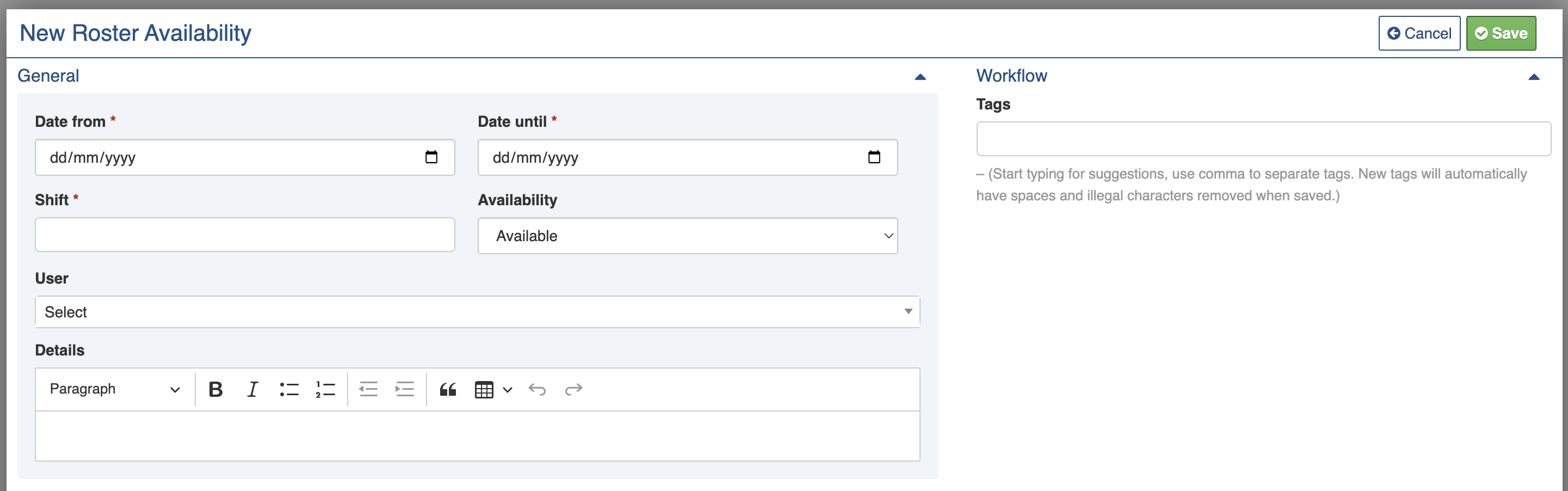
1. From the register, in the New item menu select the **New Roster Availability** <img src="/files/NlUos1WIpgZVQgn98WSo" alt="" data-size="line"> button (or drop down the list from any other register and select it)
2. Complete each section of the [Settings](#register-item-settings) as required ([Date from](#date-from), [Date until](#date-until) and [Shift](#shift) are required). If you don't select the [User](#workflow), your user will be used.
3. Save <img src="/files/87U9vdP1ZnvaOfPsT1np" alt="" data-size="line">

<figure><img src="/files/1iKKOM2Q8P804bRrnctp" alt=""><figcaption><p>New Roster Availability screen</p></figcaption></figure>

## Bulk Actions <a href="#bulk-actions" id="bulk-actions"></a>

{% content-ref url="/pages/85HyYT6h2YqK6Qk26AXL" %}
[Bulk Actions](/concepts-and-fundamentals/on-a-computer/using-the-datagrid/bulk-actions.md)
{% endcontent-ref %}

The following additional bulk actions can be performed via the Actions menu:

| Action           | Description                                                                                                                                                                     |
| ---------------- | ------------------------------------------------------------------------------------------------------------------------------------------------------------------------------- |
| Copy IDs         | Refer to: [Copy IDs](/concepts-and-fundamentals/on-a-computer/using-the-datagrid/bulk-actions.md#copy-ids)                                                                      |
| Export to Report | <p>Refer to: <a href="/pages/85HyYT6h2YqK6Qk26AXL#export-to-report">Export to Report</a><br>Exports to <a href="/pages/ihC7tECWB8A5IYs2TbmX">Roster Availability Report</a></p> |
| Bulk Edit        | Refer to: [Bulk Edit](/concepts-and-fundamentals/on-a-computer/using-the-datagrid/bulk-actions.md#bulk-edit)                                                                    |

## Importing <a href="#importing" id="importing"></a>

{% content-ref url="/pages/QP6MVwI3qEAEvatbmPc3" %}
[Imports](/system-administration/configuring-the-system/imports.md)
{% endcontent-ref %}

A System Administrator can import in bulk via the Import system using the [Availability Periods](/system-administration/configuring-the-system/imports/register-items/availability-periods.md) option.

## Reports <a href="#reports" id="reports"></a>

{% content-ref url="/pages/IwhECOjXodLQkcojUf7P" %}
[Running Reports](/system-administration/reporting/running-reports.md)
{% endcontent-ref %}

The main report, **Roster Availability** found in [Rostering Reports](broken://pages/Sg2mDOnkmBWamcjmaqdm) can be run from either the Bulk Actions or the Reports menu.

<figure><img src="/files/l610KPO27rvJRF2B4A2g" alt=""><figcaption><p>View of some of the Roster Availability Report parameters</p></figcaption></figure>


---

# Agent Instructions
This documentation is published with GitBook. GitBook is the documentation platform designed so that both humans and AI agents can read, navigate, and reason over technical content effectively. Learn more at gitbook.com.

## Querying This Documentation
If you need additional information that is not directly available in this page, you can query the documentation dynamically by asking a question.

Perform an HTTP GET request on the current page URL with the `ask` query parameter, and the optional `goal` query parameter:

```
GET https://docs.cw.crisisworks.com/concepts-and-fundamentals/on-a-computer/your-user-profile-and-duties/roster-availability.md?ask=<question>&goal=<endgoal>
```

`ask` is the immediate question: it should be specific, self-contained, and written in natural language.
`goal` is optional and describes the broader end goal you are ultimately trying to accomplish on behalf of the user. GitBook uses it to tailor the answer towards what is most useful for that goal.

The response will contain a direct answer to the question and relevant excerpts and sources from the documentation.

Use this mechanism when the answer is not explicitly present in the current page, you need clarification or additional context, or you want to retrieve related documentation sections.