> For the complete documentation index, see [llms.txt](https://docs.cw.crisisworks.com/llms.txt). Markdown versions of documentation pages are available by appending `.md` to page URLs; this page is available as [Markdown](https://docs.cw.crisisworks.com/modules/vpr.md).
# Vulnerable Persons Registers (VPR)
This section explains how to use the Vulnerable Persons Registers (VPR).
## Overview
The *Vulnerable Persons Registers* (VPR) operates across Victoria and provides 24x7 access to data by authorised emergency management agencies.
The system can be accessed via most web enabled devices and includes locality aware functions for mobile devices.
{% file src="/files/QY0zgDB16O3Lc0RYGHK6" %}
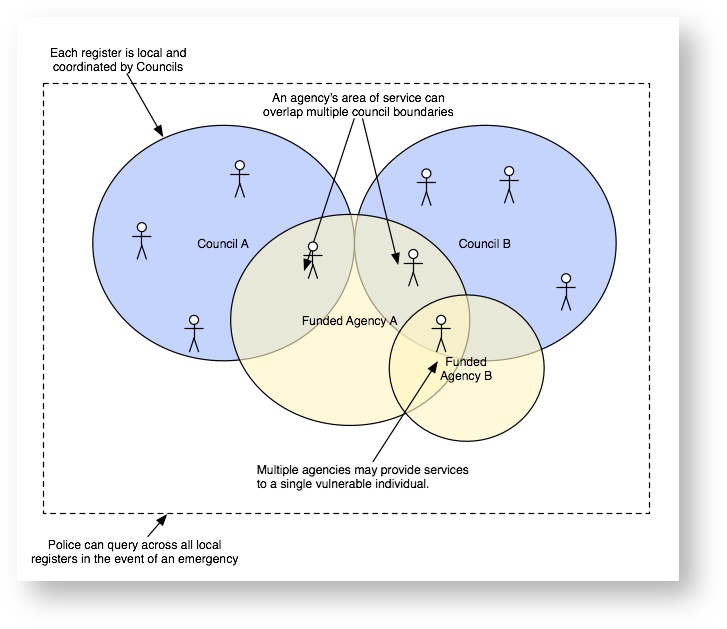
The Vulnerable Persons Registers operates at a local level to securely track vulnerable individuals, and provide a searchable database for Victoria Police during emergencies.
Funded Agencies manage the vulnerable client records, while Councils coordinate the registers, allowing Police to access the register in a self-serve way when required. Although each register is local, agencies may span across multiple municipalities, so the VPR offers agencies a single portal to manage their clients across multiple boundaries.
The system provides:
* Distributed management of vulnerable person records by Funded Agencies.
* Workflow rules to ensure data is kept current.
* High security and full auditing of user activity.
* Oversight and coordination at the local level by local governments.
* Self-serve access by Victoria Police to the register when required.
* Integration into council Crisisworks system.
* Geographic tracking and querying, and the ability to interoperate with other geographic systems.
## Client Verification
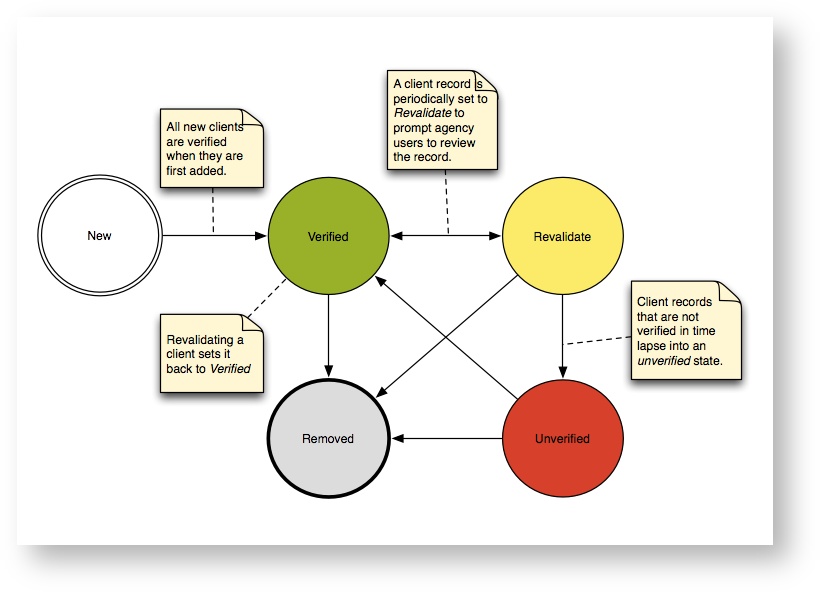
Clients require re-verification from time to time in order to ensure the data is kept accurate.
* The system will tell agency users when clients require re-verification, by setting the status of the client record to *Revalidate,* and by sending an email to the Agency Coordinators.
* When this occurs, the agency must update the record with current data and then *Verify* the client record.
* This process will typically be required twice a year, but the agency may elect to do it more frequently.
If an agency does not verify the client within 30 days of the record being flagged, the record will lapse into an *Unverified* state and the VPR Coordinator will be notified.
{% hint style="warning" %}
* It is important to keep client records in a *verified* state as much as possible.
* Once a client is removed, it is archived and cannot be reinstated.
* Victoria Police users will see all clients except those that are removed. The *Unverified* status will indicate to them that the client record may not be accurate.
{% endhint %}
## Primary and Secondary Agencies
A client will often have a relationship with multiple agencies at once, so in order to prevent duplication, the system provides a way for agencies to share an existing client record. When multiple agencies share a single client, one agency will take the role of the **Primary Agency*****,*** and the other agencies will become **Secondary Agencies**.
Although all agencies have an equal responsibility to assess the client and obtain a signed privacy consent form, the Primary Agency is the only agency that can input the client's Emergency Considerations. Additionally, the client's overall verification status is dependant on the Primary Agency's verification.
* When an agency enters a new client, a duplicate check is performed and a list of possible duplicate records will be presented to the agency user. If the client is listed, then the agency will link to that existing record and become a Secondary Agency. If no duplicates exist, the agency will be the client's Primary Agency.
* Secondary Agencies can unlink their agency from the client without removing the client from the register.
* Primary Agencies can both unlink their agency from the client, and remove the client permanently from the register.
* If a Primary Agency unlinks their agency from a client, the system will select and promote the Secondary Agency into the role of Primary Agency. If no other agencies exist, the client is referred to the VPR Coordinator for review.
For more information, agency users should consult the [For Agency Users section](/modules/vpr/for-agency-users.md).
## VPR Webinar Session
[**Training video - VPR for Agency Users**](https://s3.ap-southeast-2.amazonaws.com/cms-static.datalink.com.au/crisisworks/videos/vpr/VPR-Agency-Users-2024-04-Final.mp4) (60 mins)
All FAQs from this video are addressed in this [Guidance document](https://datalink.atlassian.net/wiki/download/attachments/105234738/Guidance%20to%20Support%20Managing%20Vulnerable%20Persons%20Registers%20and%20%E2%80%98At-Risk%E2%80%99%20Local%20Facility%20Lists.pdf?version=1\&modificationDate=1727756535855\&cacheVersion=1\&api=v2)
---
# Agent Instructions
This documentation is published with GitBook. GitBook is the documentation platform designed so that both humans and AI agents can read, navigate, and reason over technical content effectively. Learn more at gitbook.com.
## Querying This Documentation
If you need additional information that is not directly available in this page, you can query the documentation dynamically by asking a question.
Perform an HTTP GET request on the current page URL with the `ask` query parameter, and the optional `goal` query parameter:
```
GET https://docs.cw.crisisworks.com/modules/vpr.md?ask=&goal=
```
`ask` is the immediate question: it should be specific, self-contained, and written in natural language.
`goal` is optional and describes the broader end goal you are ultimately trying to accomplish on behalf of the user. GitBook uses it to tailor the answer towards what is most useful for that goal.
The response will contain a direct answer to the question and relevant excerpts and sources from the documentation.
Use this mechanism when the answer is not explicitly present in the current page, you need clarification or additional context, or you want to retrieve related documentation sections.